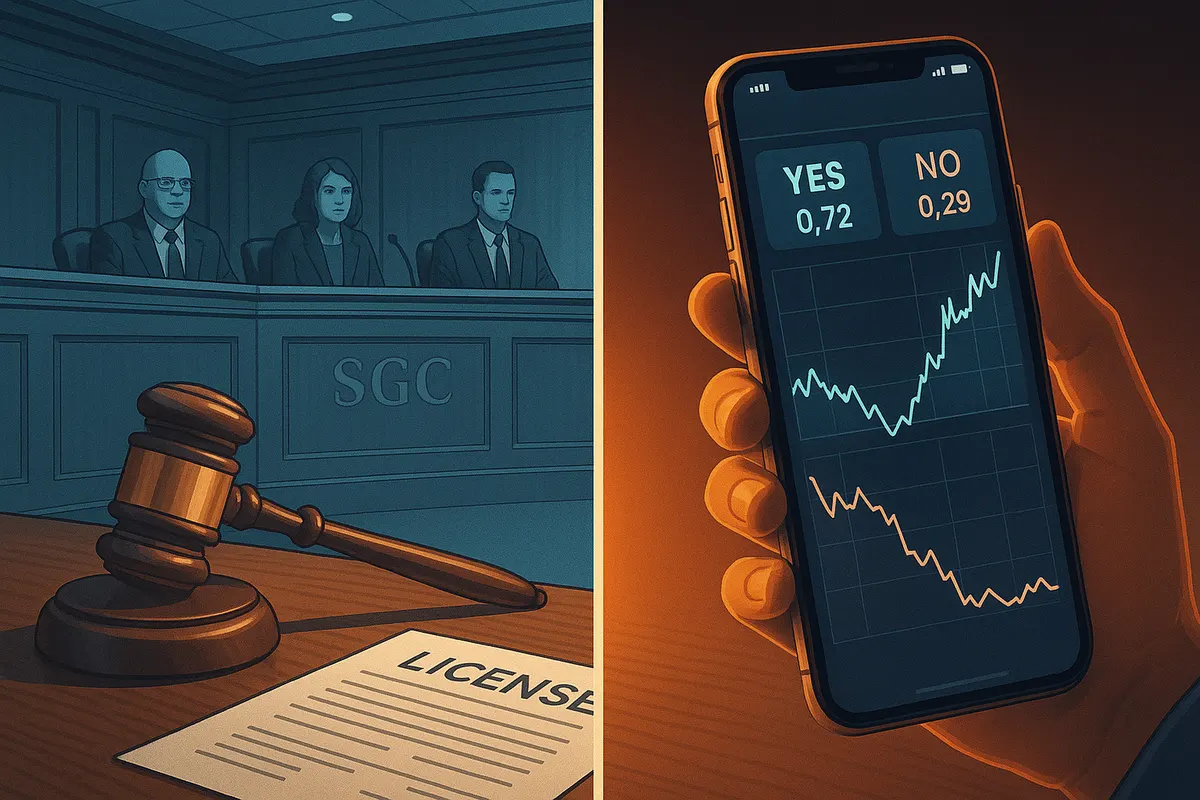
Forty-five of America’s 50 state attorneys general are on record opposing prediction markets. That is not a debate, it is a pile-on. And it explains why a G2E panel that was billed as educational turned into one of the sharpest exchanges on the conference floor.
The session, titled “Prediction Markets, Regulatory Oversight and Integrity,” was opened by moderator Rebecca Darin Goldberg with a promise that it would be more instructive than contentious. Within a few minutes, that promise was in trouble. The short version of what followed: prediction markets regulation is now the single biggest unsettled question in Western betting, and the answer will shape what “licensed” means for the next decade. Here is what was said, why it matters, and what it changes for anyone placing a bet.
What are prediction markets, and how does event contract betting work?
A prediction market is an exchange where people trade contracts on whether a future event happens. Each contract settles at a fixed value if the event occurs and at zero if it does not. Buy a “yes” contract at 40 cents and you are effectively paying for a 40% implied probability; if the event happens, the contract settles at its full value, and if it doesn’t, you lose what you paid.
Two things separate that from a bet slip. First, you are trading against other participants, not against a house that prices the market with a built-in margin, and the platform typically earns a commission on volume instead. Second, prices move continuously, so you can sell out of a position before the event resolves rather than waiting for a result.
The format is not new. These markets grew up in the United States as tools for forecasting presidential elections and later for hedging risk in commodities such as crops, which is why they sit under the Commodity Futures Trading Commission rather than a gaming regulator. What is new is the subject matter. Typical contracts now include:
- Which candidate wins an election, or whether an economic indicator lands above a threshold
- Whether a specific team wins a game or a player hits a statistical mark
- Peripheral sports questions, such as a coach being fired, a player trade going through, or a college transfer-portal move
That third bucket is where the argument starts.
Inside the G2E gaming expo showdown
Shawn Fluharty, a West Virginia legislator who also heads government affairs at Play’n Go, set the tone with the line the room remembered. Legal sports betting, he said, is a fine bottle of wine. Prediction markets are something else entirely.
“It’s basically moonshine,” Fluharty said. “It’s not licensed. It’s not regulated. It’s great for tailgates, maybe, but you don’t know what the hell you’re getting.”
Joe Casole, vice president of legal and regulatory affairs at IC360, made the more uncomfortable point. Open a licensed online sportsbook app, then open a CFTC-regulated app, and the user sees roughly the same thing: the chance to stake money on a sporting event or a player outcome. Because both live on a phone screen, he argued, the industry has to talk about the practical reality rather than the legal theory.
He also listed what the newer markets cover that a regulated book generally does not: player trades, transfer-portal moves, coach hirings and firings, and assorted peripheral outcomes on the edges of a game.
Tres York, vice president of government relations at the American Gaming Association, brought the numbers. Beyond the 45 attorneys general in opposition, he pointed to 43 state or federal court matters filed against prediction markets, of which states have won 38 — roughly 88%.
“It’s a very broad coalition,” York said, framing it as a states’ rights question, a consumer-protection question and a tribal-sovereignty question at the same time. His expectation: with a circuit split this significant, the fight ends at the Supreme Court.
Prediction markets vs sportsbooks: where the two models diverge
The products look similar on a screen. Underneath, they are built on different legal foundations, and that difference is the whole story.
| Feature | Licensed sportsbook | Prediction market (event contracts) |
|---|---|---|
| Primary oversight | State gaming commission or national gambling regulator | Federal commodities framework (CFTC in the US) |
| Who you wager against | The operator, which prices in a margin (the house edge) | Other participants; the venue takes a commission |
| Entry requirements for the operator | Suitability checks, licensing fees, state-set tax rates | Registration under commodities rules, not gaming licensing |
| Market scope | Approved sports markets; some bet types banned outright | Broader, including non-game events and peripheral outcomes |
| Player exit before settlement | Cash-out where offered, at the operator’s discretion | Sell the position at the current market price |
| Complaint route | The licensing regulator, often with a formal dispute process | The financial regulator, with no gaming-specific remedy |
Licensing and compliance requirements
York’s description of the licensed route is worth repeating because it is the crux of the complaint. When legislatures legalised sports betting, they studied the consequences, passed rules, and created an agency to oversee the market. Operators then had to pass suitability checks, pay licensing fees, accept whatever tax rate lawmakers set, and build the consumer protections written into the regulations. None of that applies in the same form to a platform operating as a commodities exchange.
Consumer protection differences
Gambling regulation comes with a specific toolkit: self-exclusion registers, deposit and loss limits, advertising restrictions, age verification standards, and funding for problem gambling services. A commodities framework was designed to police market integrity and fair dealing among traders, not to protect someone chasing losses at 2am. Those aims overlap, but they are not the same, and the gap is exactly what regulators point at.
Market structure and operations
Operationally, a book manages risk by setting prices and limiting exposure. An exchange matches buyers and sellers and profits from turnover regardless of the result. That makes exchanges indifferent to outcomes, which is a genuine strength, but it also means they have less commercial incentive to police thin, easily moved markets on obscure events.
Why gaming operators are watching this so closely
Follow the cost structure and the concern is obvious. A licensed operator pays for its licence, absorbs compliance overheads, hands over a share of revenue in tax, and accepts limits on what it can offer and how it can advertise. A competitor reaching the same customer with a similar-looking product under a different rulebook does not carry all of those costs. That is a pricing advantage before a single customer is acquired.
Then there is scope. If contracts on coach firings and player trades are permitted somewhere, licensed books lose markets they are forbidden to offer, and they lose them to a rival they cannot legally match. The tempting response is to launch an event-contract product of their own, which is precisely why gaming operators need the legal position settled before committing capital either way.
Tribal operators have a separate stake. Exclusivity compacts were negotiated on the assumption that state-regulated gaming is the only route to market. A federally supervised alternative tests that assumption directly, which is why sovereignty keeps appearing alongside consumer protection in the states’ arguments.
What gambling regulators actually worry about
Strip away the rhetoric and the objections from gambling regulators fall into three buckets.
- Protection gaps. If a platform is not licensed as a gambling business, the standard safety net — self-exclusion, enforced limits, local dispute resolution, funded treatment programmes — may not attach in the same way.
- Integrity and manipulation. Markets on transfer-portal moves, hirings and firings turn on information held by a small circle of insiders. Licensed books operate inside monitoring arrangements with leagues and integrity firms; extending that surveillance to contracts outside the gaming perimeter is harder. Thin markets are also cheaper to push around than liquid ones.
- Authority itself. States built these regimes deliberately and believe a federal commodities designation should not override them. The litigation record — 38 state wins out of 43 matters — is why they are pressing the point rather than negotiating.
What event contracts betting means for players
For a bettor, this is not an academic dispute. It changes where your money sits and who you can call when something goes wrong.
Indian readers should be clear-eyed about one thing: none of this litigation creates rights for you. The court fights are about which American authority governs these platforms, and India’s own framework is a moving mix of central and state law with real uncertainty around offshore sites. Whatever the Supreme Court eventually decides, it will not make an overseas platform accountable to an Indian player.
Practical checks before you deposit anywhere:
- Identify the actual regulator named in the terms, and confirm it supervises consumer gambling rather than only financial markets.
- Read the dispute clause. If there is no independent complaints body, your leverage after a dispute is close to zero.
- Look for working deposit limits, loss limits and self-exclusion. If those tools are absent, the platform is not built with player protection in mind.
- Understand the fee model. On an exchange you pay commission; with a book, the margin is already inside the price. Both cost you money over time.
- Assume any winnings are taxable in India and that withdrawal requires KYC. Keep your own records.
And keep the maths honest. Event contracts look like trading, complete with charts and prices, but the psychology of a market that resolves in 90 minutes is the psychology of betting. The label on the product does not change the fact that the average participant loses over time once costs are taken out. Stake only what you can afford to lose, set limits before you start, and treat any platform promising a smarter way to win with suspicion. If betting stops feeling like entertainment, use the platform’s cool-off or self-exclusion tools and seek support.
If you want the background on how licensed markets are supposed to work, our guides to sports betting regulation and choosing a safe betting platform cover the checks worth making.
Frequently asked questions
Why are regulators concerned about prediction markets?
Because the platforms reach the same customers as licensed sportsbooks without carrying the same gambling-specific obligations: suitability vetting, licensing fees, state taxes, advertising limits and mandated responsible gambling tools. Regulators also question who monitors integrity on markets covering hirings, firings and player trades.
How do prediction markets differ from sportsbooks in practice?
You trade against other participants at a price that moves, and you can sell out before the event settles. A sportsbook prices the market itself and holds a margin. The bigger difference is legal: one answers to a gaming regulator, the other to a financial one.
Is this dispute close to being resolved?
Not yet. States have won the large majority of the cases brought so far, but the AGA’s Tres York expects the circuit split to send the question to the Supreme Court. Until then, the rules depend on where the platform is registered and where you are sitting.
Tagged: event contracts G2E licensed operators prediction markets sports betting regulation