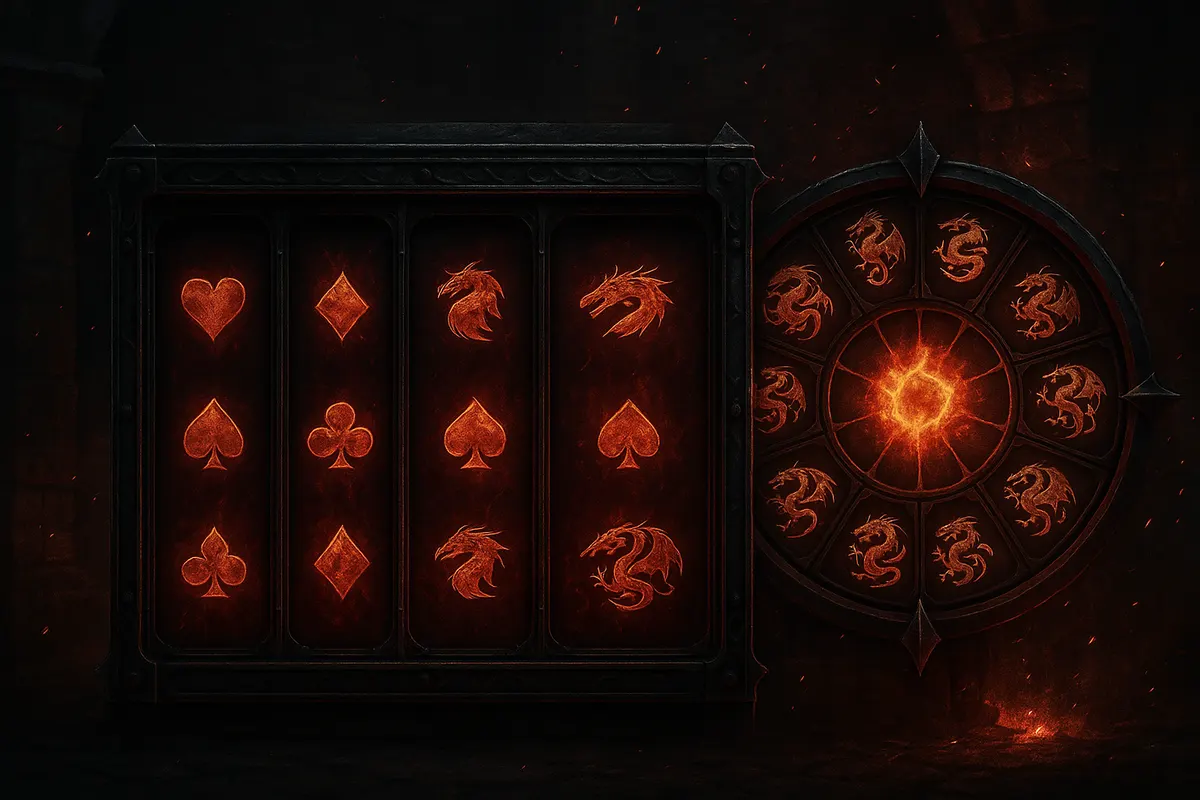
House of the Dragon Slot Review: Blueprint Gaming’s Targaryen Game Explained
A friend messaged me a screenshot the week it went live: a three-headed dragon sigil, a wheel rimmed in fire, and the caption “is this good?” He hadn’t opened the paytable. He’d seen the sigil, and that was enough. That reflex is precisely what a television licence buys, and it’s precisely why the House of the Dragon slot deserves a colder look than most new releases get.
So let’s do the cold look. What the game actually is, how branded TV slots work as a business and as a product, which numbers decide your session, and whether the Targaryen name earns the click.
What is the House of the Dragon slot?
The House of the Dragon slot is a licensed video slot from Blueprint Gaming, the British studio owned by the Merkur Group, built in partnership with Warner Bros. Discovery Global Experiences and released in late September 2026. It takes the HBO series as its setting and wraps it around a money-collection mechanic called the Dragon Wheel, plus a bonus round driven by a set of fire-themed modifiers.
It isn’t Blueprint’s first trip to Westeros. Their Game of Thrones slot arrived earlier in 2026 and, by the studio’s own account, became its strongest global launch ever in seven of its ten biggest markets. House of the Dragon is the follow-up, told from the Targaryen side of the story, and it is clearly built as part of a series rather than a one-off.
Practically speaking: same reels-and-paytable structure you already know, dressed in an IP that millions of people recognise, with a feature set designed so the bonus rounds carry the show’s beats.
Branded TV slots versus original games: what you gain and what you give up
Branded slot games exist because recognition converts. A player scrolling a lobby of 4,000 titles will stop on a name they know, and a licensed theme also comes with a ready-made cast of characters and symbols that the studio doesn’t have to explain. You already know who the Targaryens are, so the game can use the dragon as a shorthand for “big feature” without a tutorial.
What you give up is harder to see. Licences cost money, licence holders approve every asset, and the theme is fixed before the maths is. A studio working on its own IP can bend the artwork around whatever mechanic tests best. A studio working with a broadcaster’s franchise has to make the mechanic fit the story. Sometimes that produces something genuinely inventive; sometimes it produces a standard collection game with a famous logo on it.
Here’s the honest comparison:
| Factor | Branded TV slot | Original-IP slot |
|---|---|---|
| Recognition | Instant, drives lobby clicks | Built slowly through sequels |
| Theme and assets | Licensed characters, clips, music | Free rein for the studio |
| Mechanic design | Must serve the story and licensor approval | Maths and mechanic lead |
| Availability | Can be restricted or withdrawn when a licence expires | Usually stays in lobbies long term |
| RTP | Varies by title and operator version, same as any slot | Varies by title and operator version |
Note that last row. A licence tells you nothing about the return to player. Branded slots are not automatically worse value or better value. They are simply slots, and the number on the info screen is the number that matters.
The specifications that decide your session
Blueprint’s launch materials lead with features, not figures, which is normal for a new release. Before you stake anything, open the game’s information panel and read the actual numbers for the version your casino is serving. That panel is the only authoritative source, and the figures in it can differ between operators for the same title.
RTP and volatility explained
Return to player is the share of all wagers a slot pays back over the long run, averaged across millions of spins. A 96% RTP means the game returns about ₹96 per ₹100 staked on average over that enormous sample, leaving a 4% house edge. It is not a session forecast, and it is not owed to you. Most modern slots sit somewhere around 94% to 97%, and plenty of licensed titles ship in multiple RTP configurations, so a game can read 96.0% at one casino and lower at another.
The maths is simple enough to keep in your head:
| RTP | House edge | Average theoretical cost per ₹10,000 wagered |
|---|---|---|
| 97% | 3% | ₹300 |
| 96% | 4% | ₹400 |
| 95% | 5% | ₹500 |
| 94% | 6% | ₹600 |
Volatility is a separate axis. High volatility means wins arrive rarely but land larger; low volatility means small, frequent returns. It does not change RTP, it changes the shape of your bankroll graph. Collection-and-wheel games like this one tend to feel streaky by design, because a large slice of the total return is parked inside a bonus round you may not see for hundreds of spins. If you dislike long dry stretches, that structure will not suit you regardless of how good the theme is.
Paylines, bet range and maximum win
Three more things to check in the same panel: the payline or ways-to-win count, the minimum and maximum stake, and the stated maximum win expressed as a multiple of your bet. Maximum win caps matter more than people think, because a headline max of, say, several thousand times stake is a ceiling on one extreme outcome, not a typical result.
Also check whether your bet size affects feature eligibility. On some Blueprint titles, progressive jackpot participation or certain bet-mode options only apply at particular stake levels, and that detail belongs in your plan before you spin, not after. Our guide to reading RTP and volatility walks through the same checklist in more depth.
Inside the Dragon Wheel and the Dance of the Dragons bonus
The centrepiece of this Targaryen themed slot is the Dragon Wheel, a cash-collection system that runs in the base game as well as the bonus. It fires when a Dragon Wheel scatter lands alongside a collection symbol, which means you need two things on screen at once rather than a single trigger symbol, and that combination requirement is a big part of why the game feels spiky.
When it triggers, a mini wheel spins for Dragon Emblems. Those emblems award cash prizes of up to 150x your stake and can also hand out additional spins. Land the top prize on that mini wheel and the game opens its headline free spins round, built around the Dance of the Dragons, where a set of fire-themed modifiers drives the round rather than plain repeat spins.
Structurally that is a two-tier feature ladder: base-game collections that pay modestly, and a gated bonus that carries the real upside. It’s a design Blueprint has used well before, and it explains the volatility profile. Most sessions will live on the lower rung. The interesting part is finding out how often the wheel hands over the top prize, so read the paytable’s stated feature odds if the version you’re playing publishes them.
Where this sits in Blueprint Gaming’s portfolio
Blueprint has been one of the most prolific studios in the UK market for years, and licensed themes are a big slice of what it does. Alongside its own long-running series, the studio has produced slots tied to well-known television and entertainment brands, and it operates the Jackpot King progressive network that links pooled jackpots across many of its titles. It also releases a steady stream of Megaways-mechanic games under licence from Big Time Gaming.
That track record is the most useful context for this release. Blueprint knows how to build a collection-and-wheel game, and it has already proven the Westeros licence sells. If you’ve played its other branded titles, the rhythm here will feel familiar: strong presentation, a feature ladder, and a bonus round that does the heavy lifting. Our overview of Blueprint Gaming slots covers the wider catalogue.
Verdict: who this one is for
Play it if you actually like the series and you enjoy collection mechanics with a gated bonus. The IP is used properly rather than pasted on, the Dragon Wheel gives the base game something to do between features, and the up-to-150x emblem prizes mean the collection round isn’t purely decorative.
Skip it if you want frequent small returns, or if you’re only clicking because you recognised the sigil. A famous name does not improve the house edge by a single basis point, and a licensed slot with a mediocre RTP configuration is worse value than an unbranded game with a good one. Check the number first, then decide.
Whatever you conclude, treat it as paid entertainment with a negative expected return over time. Set a deposit or loss limit before you start, use the session reminders your casino offers, and stop when you hit the limit rather than when the bonus finally lands. If gambling stops feeling like a choice, use the self-exclusion tools available in your account.
Frequently asked questions
What is the House of the Dragon slot?
It is a licensed video slot from Blueprint Gaming, developed with Warner Bros. Discovery Global Experiences and released in late September 2026, based on the HBO series and built around a Dragon Wheel money-collection feature and a free spins bonus.
How does the House of the Dragon slot work?
You place a stake and spin standard reels. The Dragon Wheel feature activates when a Dragon Wheel scatter lands next to a collection symbol, triggering a mini wheel that awards Dragon Emblem cash prizes up to 150x stake plus extra spins. Winning the top prize unlocks the Dance of the Dragons free spins round with fire-themed modifiers.
What is the RTP of the House of the Dragon slot?
Check the in-game information panel at your casino. Licensed slots are often supplied in more than one RTP configuration, so the figure can vary by operator, and the paytable for the version you’re playing is the only reliable source. For context, most modern slots fall between roughly 94% and 97%, which is a 3% to 6% house edge.
Are branded TV slots better than original slots?
Not inherently. Licensed themes offer familiar characters and presentation, but the underlying maths is what determines value. Compare RTP, volatility and maximum win multiplier the same way you would for any unbranded game.
Tagged: Blueprint Gaming branded slots House of the Dragon RTP and volatility slot reviews