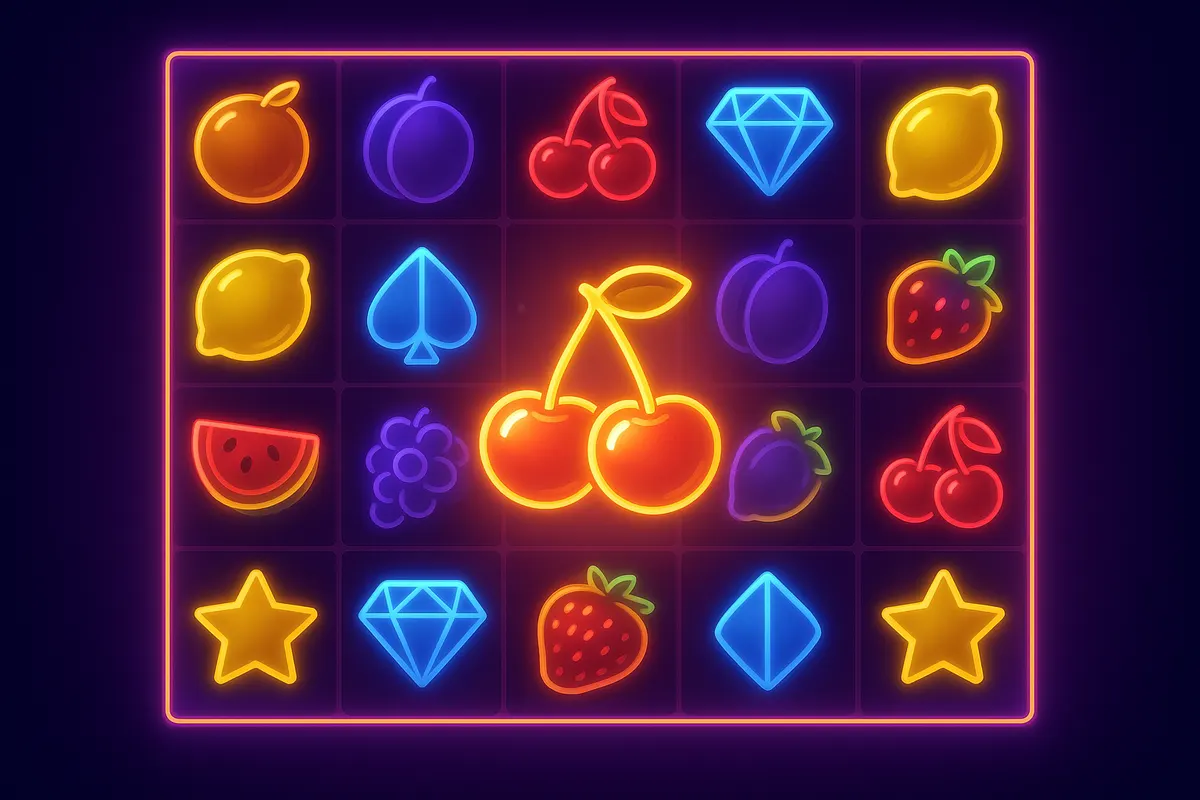
What is Bonanza Billion Merge Up?
Bonanza Billion Merge Up is BGaming’s new fruit-and-gem slot that replaces the usual cascade behaviour with a merge: winning symbols don’t vanish, they fuse into a single symbol that stays on the grid. That’s the one-line version. It’s also where things get more interesting than a normal sequel, because the merge doesn’t just look different, it changes what the grid looks like going into the next drop.
The game, released under the full name Bonanza Billion Merge Up+, sits in BGaming’s #Entertainment series and marries the visual identity of the original Bonanza Billion, now five years old, with a reworked version of the studio’s Merge Up mechanic. BGaming says the series has been a hit largely on the strength of that fruit-and-gem look and its tumble-driven pacing, so the studio kept the skin and rebuilt the engine underneath.
The confirmed specs from the launch announcement are short but meaningful:
- High volatility math model, so expect long dry stretches punctuated by bigger, rarer hits
- 97.04% RTP, per BGaming’s published figure
- A maximum win of ×15,000 your stake, which BGaming also cites as up to €255,000
- Free spins bonus carrying multipliers of up to 100x
- A Buy Bonus option priced at 100x your stake
- The reworked Merge Up mechanic, tuned using feedback from players and streamers
BGaming publishes an RTP of 97.04% and a maximum win of ×15,000 for Bonanza Billion Merge Up+. Both figures also appear in the game’s own info panel at whichever casino you open it in, and operators occasionally run games at different RTP configurations, so the paytable in front of you is the only number that matters. Check it before your first spin, not after.
How the merge slot mechanic works
Here’s the problem the merge mechanic is built to solve. In a standard cascade or tumble slot, every symbol involved in a win disappears and fresh symbols drop into the gaps. That’s satisfying when the replacements connect. It’s maddening when a win clears out four of the five cherries you were building toward and the board comes back looking like someone shuffled it.
Merge Up flips that. Instead of clearing the winning symbols away entirely, they combine and leave behind a symbol that was already on the reels. The board keeps a piece of what you had rather than starting fresh.
Symbol combination rules
The detail that makes this more than cosmetic is how the surviving symbol is chosen. According to BGaming, the more copies of a given symbol are already in play, the higher the probability that the merge resolves into that same symbol. So the grid has a mild tendency to concentrate rather than scatter. A board that’s already leaning heavily toward one fruit is more likely to keep leaning that way after a merge resolves.
Practically, that means a chain of drops can build toward density instead of constantly resetting it. You get sequences where each merge leaves behind exactly the symbol you wanted, and then the next drop adds to the pile. It feels like momentum. Just be clear-eyed about what that is: the mechanic shapes how outcomes are distributed, not how much the game returns overall. Every configuration still resolves through the RNG, and the house edge is baked into the paytable either way. A mechanic that produces more satisfying near-misses and more dramatic build-ups is a design win, not an odds win.
Triggering merge features and the free spins round
Merges aren’t a separate bonus you have to unlock. They’re the base behaviour of the game, happening automatically whenever a win lands and symbols combine. There’s no button and no trigger threshold to chase.
The bonus round is where the numbers get bigger. Free spins in Bonanza Billion Merge Up carry multiplier values of up to 100x, and the two ways in are the ordinary one, landing the trigger during normal play, and the Buy Bonus option at 100x your stake. Feature buys are worth a moment of honesty: a 100x purchase price is set by the game’s math model so the feature’s expected return lines up with what you paid for it. It’s a way to skip the wait, not a way to get ahead of the house edge. And on a high volatility model, spending 100 bets in one click means a single unlucky feature wipes out a chunk of your session budget instantly. If your normal spin is ₹10, a bonus buy is ₹1,000.
Merge slots vs traditional payline slots
If your mental model of a slot is three or five reels and a set of lines running left to right, merge slots work differently at almost every stage of a spin. Wins are evaluated by symbol groups or clusters on a grid rather than by matching positions along a fixed line, and the spin doesn’t end when the first win pays.
| Element | Traditional payline slot | Merge / cluster slot |
|---|---|---|
| Layout | Fixed reels, e.g. 5×3, with defined paylines or “ways to win” | Larger symbol grid, wins judged on the whole board |
| How wins form | Matching symbols in the right positions along a line | Enough matching symbols anywhere on the grid (cluster or scatter pays) |
| After a win pays | Spin ends, next spin starts from a clean board | Winning symbols merge or tumble, new symbols drop, evaluation repeats |
| Symbol behaviour | Symbols are static for the spin | Symbols fuse into one another and carry over within a sequence |
| Session feel | Frequent small line wins, steadier rhythm | Quiet spins, then long chain reactions that do most of the work |
| Where bonus value sits | Free spins, hold-and-win features, jackpots | Multipliers stacked during chains and free spins, plus feature buys |
One thing the table can’t show: the variance in how a session feels. Payline slots dribble out small returns. Grid-and-merge games tend to give you almost nothing for stretches and then resolve everything in a handful of spins. Same underlying idea of RTP over the long run, radically different experience over 200 spins.
Why BGaming keeps coming back to fruit and gems
Fruit themed slots are the oldest cliché in the business, and BGaming leans into it deliberately. The Bonanza Billion look, glossy fruit paired with cut gems on a bright grid, has carried the series for five years, and the studio clearly decided the sensible move was to keep the recognisable skin and swap the engine.
The theme earns its keep mechanically too. Fruit symbols are instantly readable at a glance, which matters enormously in a game where six or seven symbols are fusing at once and the board is redrawing itself repeatedly. A cluttered art style would make merge chains impossible to follow. Simple shapes and strong colours let you see at a glance that the grid is filling up with the same fruit, which is exactly the tension the mechanic is built around. Fruit also carries a clear value hierarchy for most players, low-pay fruits and high-pay gems, so you don’t need to study the paytable to know whether a big chain is worth watching.
Playing a high volatility BGaming slot sensibly
A high volatility model is the single most important fact about this release, and it should drive every decision you make at the table.
- Size your stake for survival, not for the dream. On a swingy game, a bet you can repeat a few hundred times is the only bet that lets you actually see the mechanic work. If your session budget is ₹2,000, spinning at ₹50 gives you 40 spins on a game designed around long droughts. That’s not a sample; that’s a coin flip.
- Treat the Buy Bonus as a budget decision, not a shortcut. At 100x, two unsuccessful buys are 200 spins of bankroll gone. If you want to try it, decide in advance how many you’ll buy and stop there.
- Read the info panel first. RTP, max win and the merge rules are all in-game. Different operators can host different RTP versions of the same title.
- Try the demo before real money. Merge chains take a few dozen spins to understand, and understanding them in free play costs nothing.
- Ignore the pattern instinct. The merge mechanic makes it feel like the board is “building” toward something. Each drop is still an independent random outcome, and no sequence of quiet spins makes a big one due.
Everything in the house’s favour is built into the paytable, so the realistic goal here is entertainment for a fixed, disposable amount of money. Set a deposit or loss limit before you open the game, use the session reminders your casino offers, and stop when the budget’s gone rather than chasing it. If it stops feeling like entertainment, the self-exclusion and cool-off tools exist for exactly that. Gambling is for adults only, and the legal minimum age varies by jurisdiction and game type, 18 in some states and regions but 21 for casino gambling in many US states, so check the rules that apply where you are.
Quick answers
How does the merge mechanic work?
When a win pays, the winning symbols combine instead of simply disappearing, leaving behind a single symbol that was already present on the grid. The more copies of a symbol already in play, the likelier the merge resolves into that symbol, so the board tends to concentrate as a chain continues.
How do merge slots differ from payline slots?
Payline slots pay for matching symbols in fixed positions along a line and end the spin once wins are paid. Merge slots evaluate symbol groups across a whole grid, then keep resolving as symbols fuse and new ones drop, so one spin can produce several rounds of wins.
Is Bonanza Billion Merge Up worth playing for beginners?
It’s readable and the mechanic is easy to grasp, but the high volatility math makes it unforgiving on a small bankroll. Start in demo mode, then play at the smallest stake your casino allows if you move to real money.
For more on how grid-based games evaluate wins, see our guide to slot mechanics and RTP, and our roundup of BGaming slot releases for how this fits the studio’s wider catalogue.
Tagged: BGaming fruit themed slots merge slots new slot releases slot mechanics