How Tribal Casino Community Events Like the Morongo Powwow Actually Get Funded
Who pays when 30,000 people walk into a powwow for free?
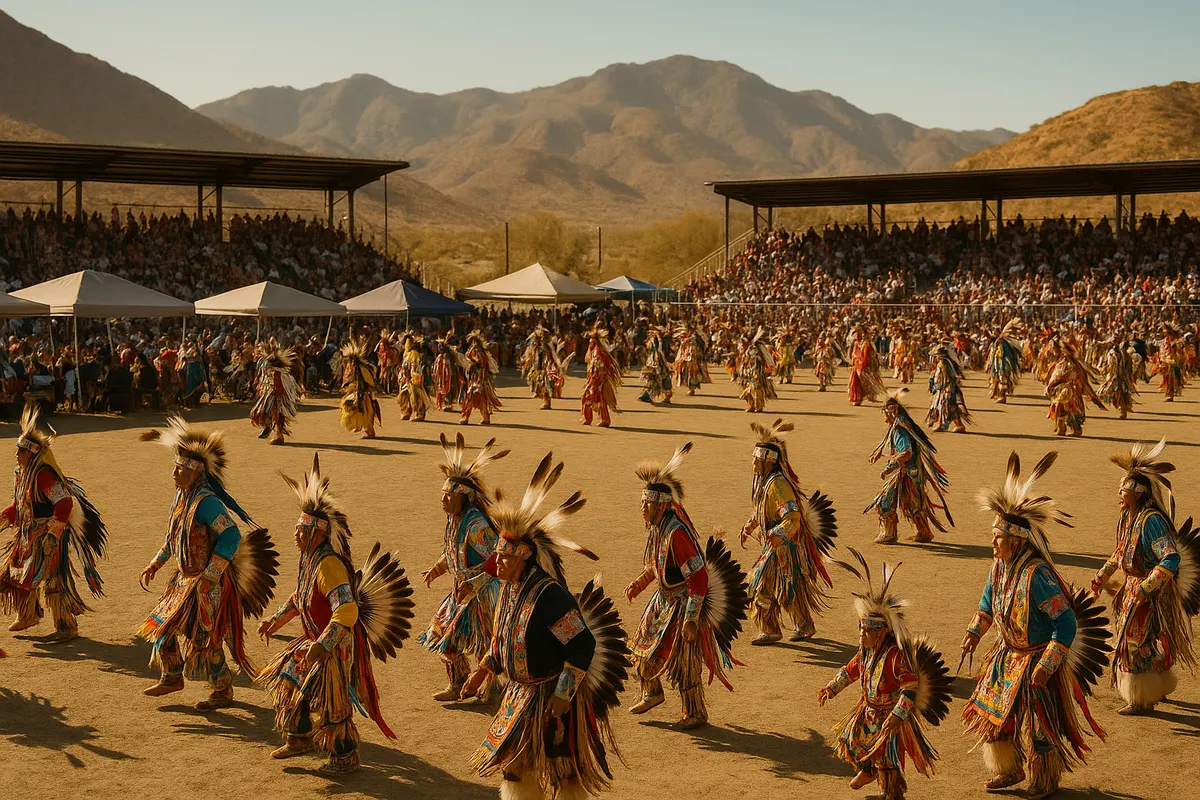
That is the question worth sitting with, because it is the fastest route into understanding how tribal casino community events are financed in the United States. Over three days in late September, more than 30,000 spectators attended the 35th Annual Morongo Thunder & Lightning Powwow on the Morongo Indian Reservation in Banning, California. Admission cost nothing. Somebody still paid for the arena, the prize money for more than 900 dancers, the sound, the security, the parking, the sanitation. In Morongo’s case, and in dozens of similar cases across the country, that somebody is a tribal government whose general fund is underwritten in large part by gaming.
My thesis is simple: free-to-attend cultural events are one of the most visible and least discussed outputs of the tribal gaming industry. If you follow casinos as a player or as an industry watcher, the Morongo powwow is a better explainer of the tribal business model than most balance sheets.
The numbers behind the 35th Morongo powwow
Start with what actually happened, as reported by CDC Gaming:
- More than 30,000 spectators across September 25–27.
- More than 900 dancers and 20 drum groups travelling from across the U.S. and Canada.
- More than 115 vendors in the Morongo Indian Market selling baskets, beadwork, jewellery, clothing and pottery.
- Opening day timed to California Native American Day.
- Free admission, family-friendly, with Grand Entry each day as the centrepiece.
Alongside the competitive dancing there was traditional drumming, Bird Singing, and peon games of the Morongo Band of Mission Indians and other Southern California tribes. Food vendors sold Indian tacos and frybread. Tribal Chairman Charles Martin framed the purpose in cultural rather than commercial terms: the powwow, he said, is “about renewing our commitment to our traditions and about making sure our culture, our heritage and our values continue to live on through our young people.”
Read that against the economics for a second. An event at that scale, run 35 years in a row, with no gate revenue, is an expense line. It only exists because the government hosting it has an income stream that does not depend on ticket sales. That income stream, for the Morongo Band, includes the Morongo Casino Resort & Spa off Interstate 10.
The law that makes casino community funding possible
This is not goodwill operating in a vacuum. It is statute. Under the Indian Gaming Regulatory Act of 1988, net revenues from tribal gaming can only be spent on a short, defined list of purposes. Tribes may use gaming money to:
- Fund tribal government operations or programs.
- Provide for the general welfare of the tribe and its members.
- Promote tribal economic development.
- Donate to charitable organisations.
- Help fund operations of local government agencies.
Those categories are where cultural programming lives. A powwow, a language program, a youth dance class, a museum, a scholarship fund, an elders’ centre: all of it sits comfortably inside “tribal government operations” and “general welfare.” Compliance with those spending rules is overseen by tribal gaming agencies alongside the federal National Indian Gaming Commission, which regulates the industry and publishes annual gross gaming revenue figures for tribal operations nationwide.
In California specifically, Class III casino gaming on tribal land operates under tribal-state compacts, a structure voters endorsed at the ballot box in 2000. Those compacts also created revenue sharing mechanisms so that tribes without large casinos receive payments funded by those that do. So “tribal gaming revenue” is rarely a single-tribe story; it moves sideways across tribal governments as well as outward into surrounding counties.
How the tribal model differs from a commercial casino
If you have only ever thought about casinos as listed companies with shareholders, the difference in where the money lands is the part to internalise.
| Feature | Commercial casino | Tribal casino (U.S.) |
|---|---|---|
| Owner | Private company or public shareholders | A tribal government, on behalf of its citizens |
| Where profit goes | Dividends, buybacks, reinvestment | Restricted to the five IGRA-permitted uses |
| Primary regulator | State gaming board or commission | Tribal gaming agency plus the NIGC; Class III also governed by a tribal-state compact |
| Payments to the state | State gaming tax on revenue | Compact-negotiated revenue sharing and mitigation payments |
| Typical community output | CSR budget, sponsorships | Government services, cultural programs, free public events |
None of that makes tribal gaming charitable. A casino floor is still a casino floor: the house edge is built into every game, and slot machines returning roughly 94–97% of wagers over the long run are what generate the surplus in the first place. The distinction is structural, not moral. In the tribal model, the operator and the government are the same entity, so the surplus funds public goods directly instead of passing through a corporate tax line first.
Why a free powwow is also sound business
I would be doing you a disservice by pretending culture and commerce sit in separate rooms here. They do not, and tribal leaders are candid about it.
A three-day event that pulls 30,000 people into Banning fills hotel rooms, restaurants and gas stations across the Inland Empire. It puts 115 independent Native artists in front of a paying audience, which is small business development rather than handouts. It gives a casino resort a non-gaming reason to appear in regional press and in the feeds of people who would never read a slots review. And it demonstrates, in public, exactly what tribal sovereignty produces when it is funded, which matters enormously every time gaming legislation reaches a state legislature or a ballot.
Chairman Martin’s emphasis on young people points at the other return: cultural continuity. Bird Singing and peon games are not tourist content. They are practices that need occasions, and occasions need budgets.
What this means if you follow the gaming industry
Three practical takeaways for anyone tracking the sector.
Tribal opposition to online expansion is rational, not reflexive. When a tribal government’s ability to fund its programs rests on a physical property, any proposal that moves wagering to phones is a proposal to move revenue off its land. That is a large part of why California’s two 2022 sports betting ballot measures, the tribal-backed retail model and the operator-backed online model, were both rejected by voters after a bruising campaign. Understand the funding structure and the politics stop looking mysterious.
Compacts are the real rulebook. If you want to know what a tribe can offer, which game categories, which technologies, which revenue sharing obligations apply, the compact and IGRA’s Class II/Class III distinction tell you more than any press release will.
Community spending is a competitive asset. Events like the Morongo powwow build political capital that commercial operators cannot easily buy, and that capital gets spent in exactly the rooms where gaming expansion is decided.
Frequently asked questions
Do tribal casinos have to spend money on the community?
Yes, within limits. IGRA restricts net gaming revenues to five purposes: tribal government operations, the general welfare of tribal members, economic development, charitable donations and support for local government agencies. Tribes decide the specific programs within those categories.
Was the Morongo Powwow free to attend?
Yes. Admission to the 35th Annual Morongo Thunder & Lightning Powwow was free, with the costs carried by the Morongo Band of Mission Indians as host.
Are tribal casino games different from commercial ones?
Mechanically, Class III games such as slots, blackjack and roulette work the same way anywhere: outcomes are produced by an RNG or by the physical game, and each game carries a house edge, the inverse of its RTP. Class II gaming, based on bingo mechanics, is regulated separately and can look like slots while running on different math.
How large is the tribal gaming industry?
It is one of the biggest segments of U.S. gaming by revenue, spanning hundreds of operations across dozens of states. The National Indian Gaming Commission releases audited gross gaming revenue totals each year, and that is the figure to cite rather than industry estimates.
One last note, since we are talking about where casino money comes from: it comes from players losing more than they win over time, because that is how the house edge works. Set a deposit or loss limit before you play, treat the spend as entertainment rather than income, and use the self-exclusion and cool-off tools any licensed operator is required to provide.
Tagged: casino industry morongo casino native american gaming responsible gambling tribal gaming